What Bunkering Really Means in the Maritime Industry
Bunkering and crude oil theft are often wrongly treated as the same activity, especially in discussions about the Niger Delta. This article explains the critical differences between legitimate ship fueling operations and illegal oil theft, highlighting why accurate terminology matters for maritime regulation, environmental protection, and industry accountability.
VESSEL OPERATIONS
7/10/20263 min read
Bunkering Operation vs. Oil Theft: Understanding the Difference
The term "bunkering" is frequently used in discussions about the Niger Delta, often appearing in news reports, policy debates, and everyday conversations. However, one of the most common misconceptions in Nigeria's oil and maritime sectors is the tendency to use the word "bunkering" interchangeably with crude oil theft.
In reality, they are two very different activities. One is a legitimate maritime service that supports global trade, while the other is a criminal enterprise that damages the environment, undermines economic development, and threatens national security.
Understanding the distinction is essential for anyone interested in shipping, energy, environmental protection, or maritime affairs.
What Is Bunkering?
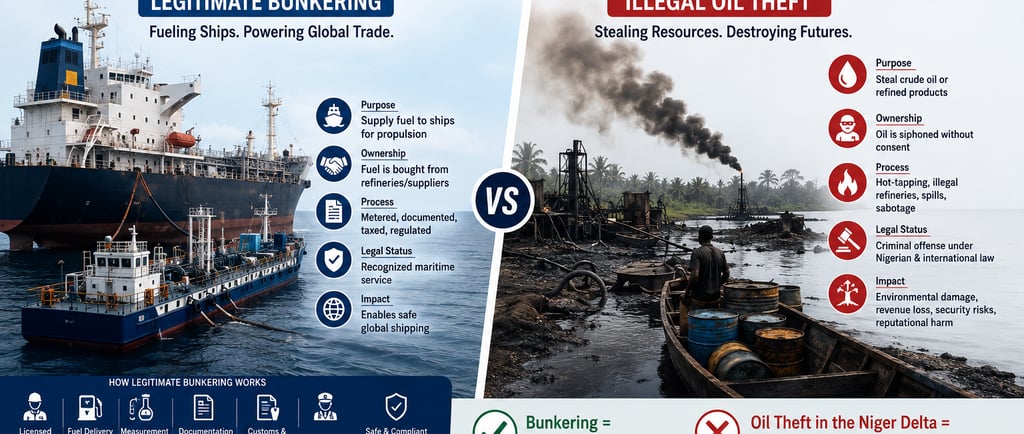
Bunkering is the process of supplying fuel to a ship for use in its engines and onboard machinery. The fuel may be heavy fuel oil, marine diesel oil, marine gas oil, or liquefied natural gas (LNG), depending on the vessel's requirements.
A bunkering operation is similar to refueling a vehicle, except it takes place on a much larger scale and under strict regulatory oversight. Fuel is delivered by licensed suppliers, often using bunker barges, pipelines, or specialized terminal facilities.
These operations typically occur at ports, anchorages, or offshore locations and are carefully planned to ensure safety, environmental compliance, and fuel quality.
How Legitimate Bunkering Works
Legitimate bunkering involves several layers of documentation and verification.
Before fuel is transferred, the supplier and receiving vessel agree on the quantity and specifications of the fuel. During the operation, measurements are taken, samples are collected for quality testing, and records are maintained.
The transaction is supported by documents such as Bunker Delivery Notes (BDNs), quantity surveys, customs clearances, and laboratory reports. Every quantity of fuel delivered is measured, accounted for, and paid for.
International regulations, including MARPOL Annex VI and the IMO's sulfur-emission requirements, govern bunkering operations worldwide. Port authorities, flag states, and environmental agencies also monitor compliance to ensure safe and responsible fuel handling.
Without bunkering, ships would be unable to complete their voyages, making it a critical component of global commerce and maritime logistics.
What Happens in the Niger Delta?
Unlike legitimate bunkering, crude oil theft involves the unauthorized extraction or diversion of crude oil and petroleum products from pipelines, flow stations, wellheads, or storage facilities.
Criminal groups often gain access to pipelines through illegal connections known as "hot taps." The stolen crude may then be transported through hidden networks, loaded onto vessels, or processed in makeshift refining sites commonly referred to as illegal refineries or "kpo-fire" operations.
These activities occur without authorization from asset owners, regulatory agencies, or government authorities.
The objective is not to fuel ships but to profit from the illegal sale of stolen petroleum products.
Why Calling Oil Theft "Bunkering" Is Misleading
The confusion stems largely from historical usage. During the 1980s and 1990s, criminal networks involved in stealing crude oil began using the term "bunkering" to describe their activities, particularly when stolen crude was transferred to vessels offshore.
Over time, the phrase "illegal bunkering" entered public discourse and became widely used by media organizations and commentators.
However, the label creates a false equivalence between a lawful maritime service and a criminal act.
A useful comparison is banking. Making a withdrawal from your account is a legal financial transaction. Robbing a bank is a crime. Although both involve money, they are fundamentally different activities.
The same principle applies here. Bunkering is a regulated commercial service. Crude oil theft is theft.
The Consequences of Crude Oil Theft
The impact of crude oil theft extends far beyond financial losses.
Illegal tapping of pipelines frequently leads to oil spills that contaminate rivers, creeks, farmlands, and fishing grounds throughout the Niger Delta. Communities that depend on these ecosystems for their livelihoods often bear the greatest burden.
The practice also deprives governments and companies of revenue, discourages investment, increases operational costs, and creates security challenges in oil-producing regions.
In addition, incidents of pipeline vandalism and illegal refining contribute to air pollution, environmental degradation, and reputational damage for Nigeria's petroleum sector.
Why the Distinction Matters
Using accurate terminology is more than a matter of semantics. The words used to describe a problem often influence how that problem is addressed.
Bunkering requires effective regulation, safety standards, environmental compliance, and quality assurance.
Crude oil theft requires law enforcement, asset protection, community engagement, environmental remediation, and stronger governance.
Treating these distinct issues as though they are the same can lead to misunderstandings and ineffective solutions.
Conclusion
Bunkering is the legal and regulated process of supplying fuel to ships. It is an essential maritime service that enables vessels to operate safely and efficiently around the world.
Crude oil theft in the Niger Delta, on the other hand, involves the illegal extraction, diversion, or sale of petroleum products through activities such as pipeline vandalism, hot tapping, and unauthorized refining.
The two should not be confused.
Protecting the maritime fuel supply chain and combating oil theft are both important priorities, but they require different approaches. The first step toward solving either challenge is understanding what it is—and calling it by its proper name.
The Maritime Nigeria Insight
Policy, infrastructure, and intelligence across Nigerian waters.
Home-Analysis-Resources-Contact
Inquiries
editor@maritimerecord.ng
Lagos, Nigeria
Updates published daily
© 2026 The Nigerian Maritime Record-The definitive digital record for Nigerian shipping and maritime regulation.
Nigerian Maritime Industry Knowledge Centre